The word custom on a dog collar can mean four or five completely different manufacturing processes, and they are not interchangeable. One dyes a full-color pattern permanently into the webbing; another stitches thread that a dog’s nails can eventually catch; another is a metal plate that will outlive the collar. If you are ordering collars in bulk with a logo, a repeating pattern, or a pet’s name, the decoration method decides how the finished product looks, how long the artwork survives, and what it costs per unit. Here is how the main methods actually differ, and how to match one to your design.
Dye-sublimation: full color that lives in the fiber
Dye-sublimation is the method behind photographic, edge-to-edge patterns on webbing. Special inks are turned to gas under heat and bond directly into the fibers, so the color becomes part of the material rather than a layer sitting on top. The practical payoff is durability: a sublimated design cannot be scratched off and does not fade or lighten with normal wear, which makes it a strong choice for dogs that scratch at their collars. The one hard constraint is the substrate. Sublimation bonds to polyester, not nylon, so a full-color sublimated collar is a polyester-webbing product by definition. If you want a busy pattern, a gradient, or a photo-like image across the whole strap, this is almost always the method.
Screen print and embroidery: spot color and thread
Screen printing pushes ink through a stencil onto the webbing, one screen per color. It is efficient for simple, bold spot-color logos and text, but it has two limits worth knowing: the number of distinct colors is capped by the number of screens, and the ink sits on the surface, so it can crack or wear over years of handling. Embroidery takes the opposite approach, building a name or small logo from stitched thread. It reads as high quality and holds color well because the color is the thread itself, but the raised stitches occupy real estate and, as collar makers note, can be caught by a dog’s nails during persistent scratching. Embroidery suits names and compact marks far better than large or photographic artwork. A useful rule of thumb: screen print rewards flat, high-contrast shapes with clean edges, while embroidery rewards short text and simple icons where the stitch direction can follow the form.
Woven webbing and engraved hardware: built-in and permanent
Jacquard weaving builds the pattern into the webbing on the loom, using colored threads rather than ink. The result is exceptionally durable because there is no surface layer to wear, and it has a distinctive textured look, but the palette is limited to a handful of thread colors and fine photographic detail is off the table. It shines for repeating logos and geometric patterns produced at volume. Engraved hardware is a different animal entirely: a name and phone number laser-etched or debossed into a metal buckle or a riveted nameplate. It carries no field color and only a small amount of text, but it is effectively permanent and pairs with any webbing decoration, which is why identification is often engraved even when the strap itself is printed or woven.
Matching method to color, wear, and webbing
Line the methods up against the two things buyers care about most, color capability and how well the decoration survives, and the choice usually makes itself. Full-color, photographic, or gradient artwork points to sublimation. A simple bold logo in one or two colors is a natural screen print. A repeating pattern you want to feel premium and last for years leans woven. A pet’s name is embroidery or an engraved plate. The chart below is an orientation aid rather than a lab result, but it captures the trade-off: the methods that carry the richest color are not always the ones that resist wear the best.
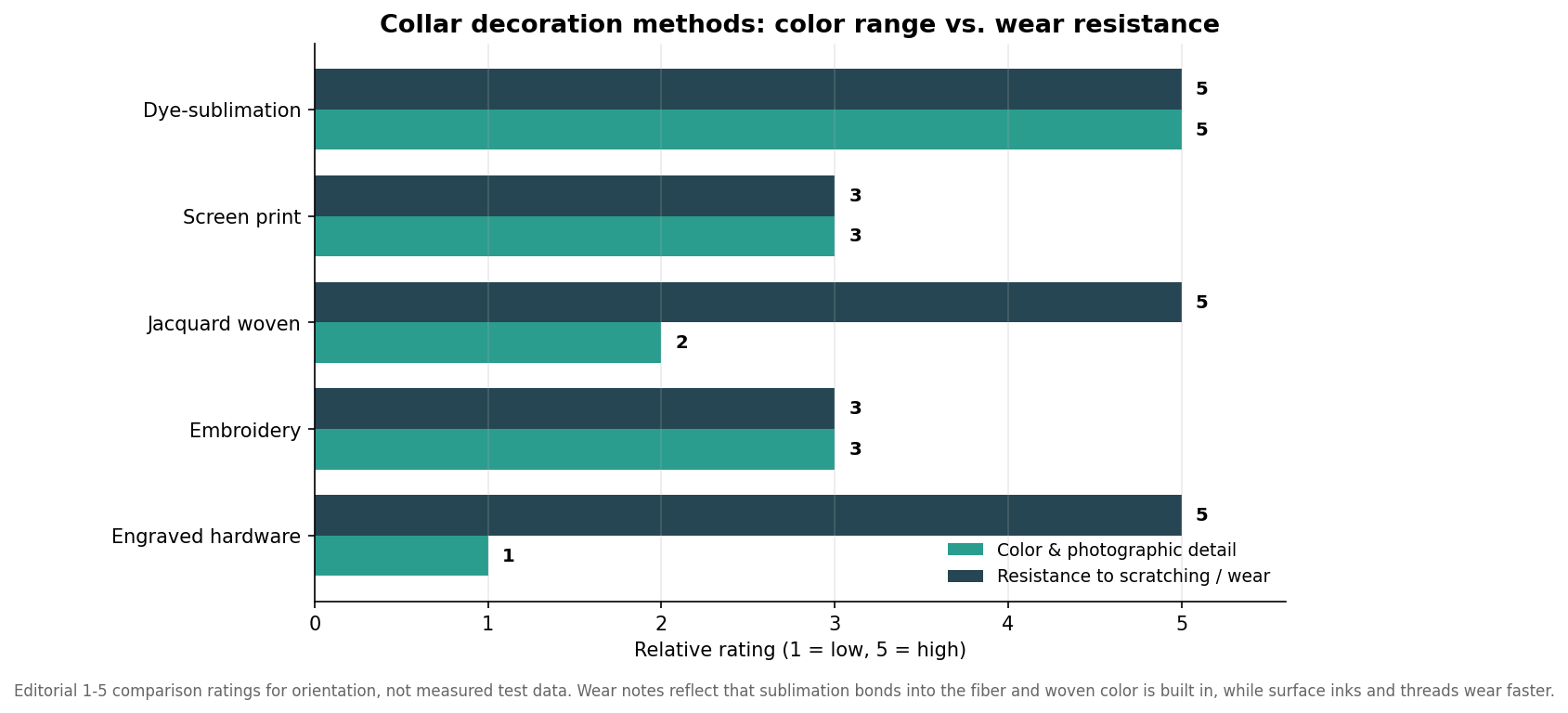
Remember that the method can dictate the webbing, not just the artwork. Choosing sublimation commits you to polyester; choosing woven commits you to a loom setup and a limited palette. Decide the look first, then let it tell you which webbing and process the order actually requires.
Width is your design canvas
Whatever method you pick, the collar’s width sets how much design can actually read. Standard webbing runs from three-eighths of an inch for the smallest dogs up to an inch and a half for the largest, and each step up gives a pattern or logo meaningfully more room. A detailed sublimated image or a woven repeat needs the width to breathe, which is why busy artwork looks crisp on a one-inch strap and muddy on a three-eighths-inch one.
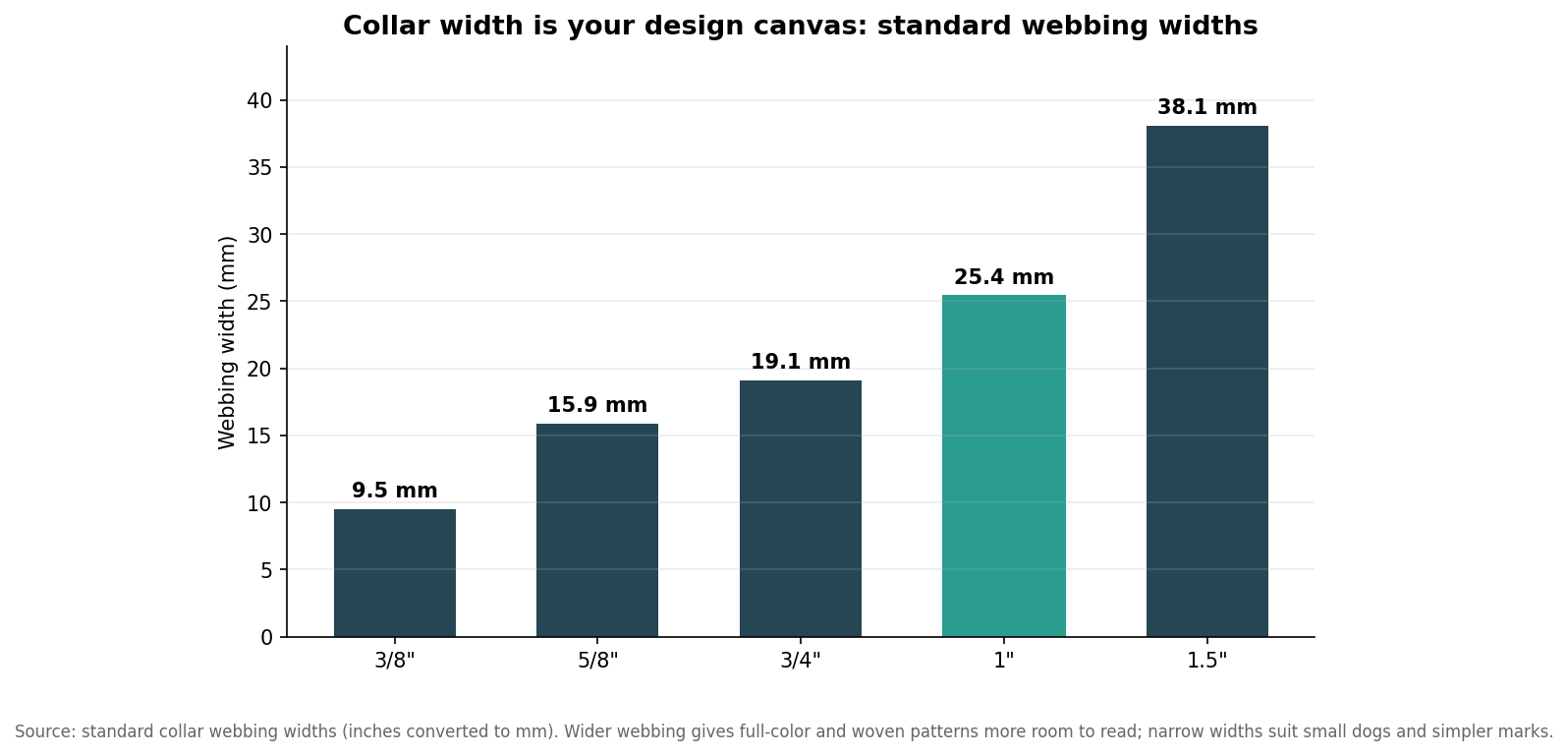
Match the ambition of the artwork to the width you are ordering. Fine multi-color detail belongs on wider webbing; a narrow collar for a small dog is better served by a simple mark, a single embroidered name, or an engraved buckle than by a crowded full-color print that no one can make out.
Bring the design and the constraints together before you request a quote: the artwork type, whether it is full color or a few spot colors, the webbing width you need for the dog size, and how hard the collar will be worn. Minimum order quantities and per-unit pricing shift with the method, the number of colors, and whether custom webbing is involved, so treat any single figure as indicative until it is quoted in writing. Choose the decoration method deliberately and the collar that arrives shows the design you intended and keeps showing it after a year of walks.