When a buyer orders custom dog collars in bulk, the print method usually gets all the attention and the strap material gets almost none. That is backward. The webbing or leather under the artwork decides how long the collar survives, how it handles water and odor, and, critically for a printed collar, whether the color you approved still looks that way a year later. Four materials cover the vast majority of custom collars, and they behave very differently. This is a closer look at each, with an eye toward the decisions a bulk custom order actually forces.
The four materials, and what sets them apart
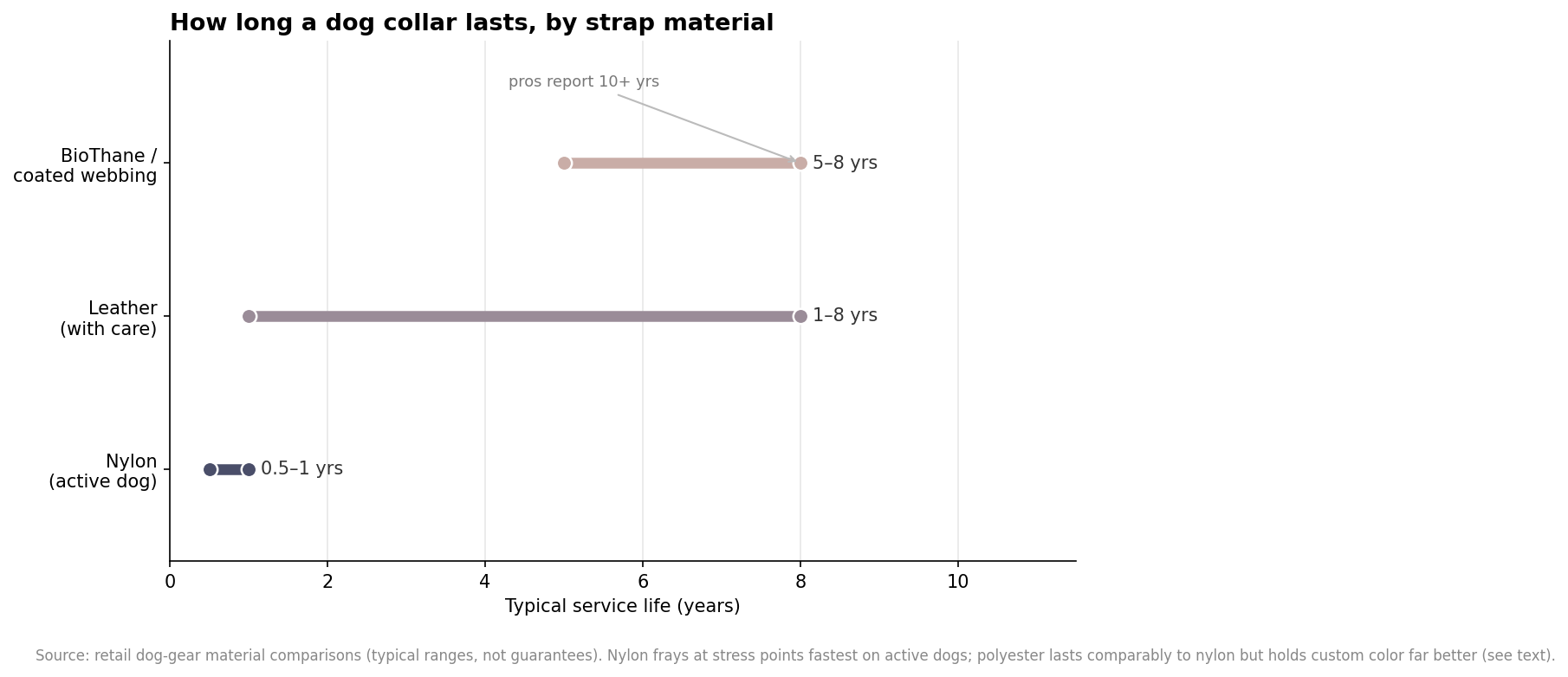
Nylon is the default budget webbing: inexpensive, widely available, and strong for its weight. Its weaknesses are the flip side of that. Nylon readily absorbs moisture, which invites bacteria and the persistent wet-dog smell, and it tends to fray at stress points near the hardware. On an active dog, retail comparisons put its useful life at roughly six to twelve months before it looks tired. For custom work there is a subtler issue: nylon does not hold printed color as stably as polyester, so a bright pattern can dull with sun and washing.
Polyester is the quiet workhorse of custom printed collars, and it is the material to understand if the whole point of your order is decoration. Polyester webbing takes dye-sublimation printing exceptionally well, holds fine detail, and stays colorfast under UV exposure far better than nylon. It also absorbs less water and stretches less when wet, so a printed polyester collar keeps its shape and its color. Nylon is marginally stronger and more abrasion-resistant strand for strand, but for a collar that lives or dies by how its artwork ages, polyester is usually the smarter base.
BioThane and similar coated webbing is a polyester core sealed in a waterproof polymer coating, and it is the durability champion. Water beads off, nothing soaks in, so odor and bacteria are essentially non-issues, and it wipes clean with a rinse. Retail owners report five to eight years of service, with professionals citing ten or more. The coating is what makes it thrive around swimming, hunting, mud, and e-collar or GPS hardware. Its constraint for custom work is that decoration happens on or through the coating rather than by dyeing the webbing, so branding is typically embossing, printed hardware, or an attached tag rather than an all-over sublimated pattern.
Leather is the premium, traditional choice, prized for how it looks and feels and how it ages on a low-activity dog. It is also the highest-maintenance option by a wide margin. Leather is porous, so repeated wet-dry cycles invite mold and mildew, and keeping it healthy means regular conditioning. Without that care its life can be as short as a year or two; with diligent upkeep it can last many years. It is a poor match for water and rough play, and it does not take full-color custom printing the way a synthetic webbing does.
Durability is really about the dog, not the material
There is no single most durable material in the abstract; there is a most durable material for a given dog and environment. A coated webbing collar shrugs off the swimming and mud that destroy leather, while a well-maintained leather collar on a calm indoor dog can outlast a nylon one several times over. The chart below shows the typical service-life ranges, and the spread within each material is the real story: leather’s range is enormous precisely because it depends on care, and nylon’s is short because active use punishes it.
Two specification details amplify whatever material you pick. Webbing width and weight set both strength and comfort: a wider, heavier strap spreads load and resists fraying, which matters most on large or pulling dogs, while a narrow strap suits toy breeds where a broad collar would be bulky and hot. And the material has to be matched to its hardware, since a strong strap paired with a weak buckle or a thin D-ring simply moves the failure point rather than removing it. The strap and the metal fail as a system, so they should be specified as one.
The cost that shows up later
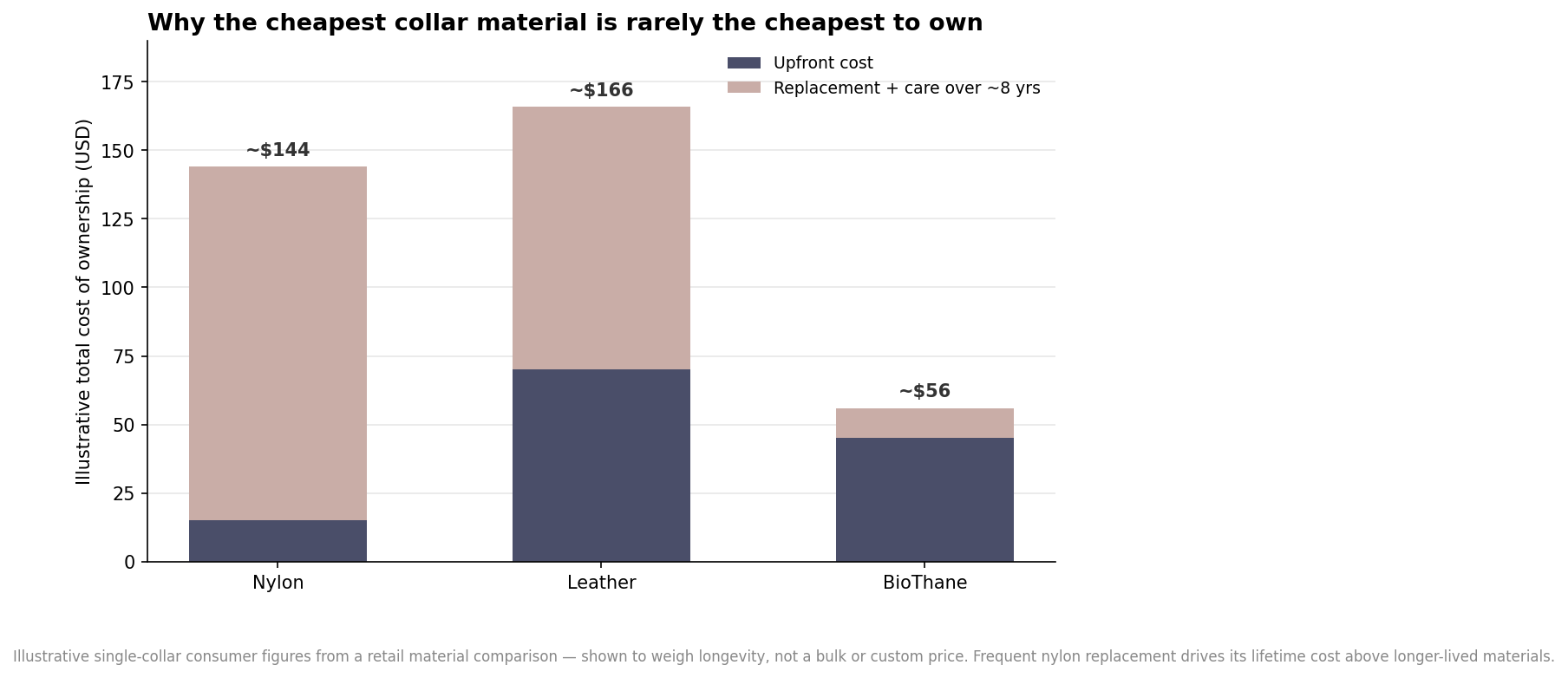
Sticker price and cost of ownership are not the same number, and for collars the gap is large. Cheap nylon looks like the economical choice until you count how often it gets replaced; longer-lived materials cost more upfront but less over the life of the dog. The illustrative comparison below uses single-collar retail figures to make the point clearly. Bulk custom pricing works differently, but the underlying logic carries straight into a wholesale decision: if you are producing collars that carry your brand, a material that fades or frays quickly costs you in reprints and in how the product represents you long after the sale.
Choosing a base material for a custom run
Start from how the collars will be used and how they will be decorated, and the material usually chooses itself. If the order is built around vivid, full-coverage artwork, specify polyester webbing so the print stays sharp and colorfast. If the collars are aimed at working, sporting, or water dogs and need to survive years of abuse, coated webbing like BioThane is the durable answer, with branding handled through embossing, hardware, or tags. If the run is a premium, low-activity lifestyle product where look and feel justify the upkeep, leather earns its place. Reserve plain nylon for genuinely price-driven or short-term uses, and go in knowing its printed color will not age as gracefully. Whatever you choose, order a printed sample in the exact material and hardware before the full run, then wet it, flex it near the buckle, and leave it in the sun for a few days. Those three tests predict how ten thousand collars will hold up far better than any spec sheet.