Category: Uncategorized

  • Custom Dog Collar Materials: Nylon, Polyester, BioThane, and Leather Compared

    Custom Dog Collar Materials: Nylon, Polyester, BioThane, and Leather Compared

    When a buyer orders custom dog collars in bulk, the print method usually gets all the attention and the strap material gets almost none. That is backward. The webbing or leather under the artwork decides how long the collar survives, how it handles water and odor, and, critically for a printed collar, whether the color you approved still looks that way a year later. Four materials cover the vast majority of custom collars, and they behave very differently. This is a closer look at each, with an eye toward the decisions a bulk custom order actually forces.

    The four materials, and what sets them apart

    Nylon is the default budget webbing: inexpensive, widely available, and strong for its weight. Its weaknesses are the flip side of that. Nylon readily absorbs moisture, which invites bacteria and the persistent wet-dog smell, and it tends to fray at stress points near the hardware. On an active dog, retail comparisons put its useful life at roughly six to twelve months before it looks tired. For custom work there is a subtler issue: nylon does not hold printed color as stably as polyester, so a bright pattern can dull with sun and washing.

    Polyester is the quiet workhorse of custom printed collars, and it is the material to understand if the whole point of your order is decoration. Polyester webbing takes dye-sublimation printing exceptionally well, holds fine detail, and stays colorfast under UV exposure far better than nylon. It also absorbs less water and stretches less when wet, so a printed polyester collar keeps its shape and its color. Nylon is marginally stronger and more abrasion-resistant strand for strand, but for a collar that lives or dies by how its artwork ages, polyester is usually the smarter base.

    BioThane and similar coated webbing is a polyester core sealed in a waterproof polymer coating, and it is the durability champion. Water beads off, nothing soaks in, so odor and bacteria are essentially non-issues, and it wipes clean with a rinse. Retail owners report five to eight years of service, with professionals citing ten or more. The coating is what makes it thrive around swimming, hunting, mud, and e-collar or GPS hardware. Its constraint for custom work is that decoration happens on or through the coating rather than by dyeing the webbing, so branding is typically embossing, printed hardware, or an attached tag rather than an all-over sublimated pattern.

    Leather is the premium, traditional choice, prized for how it looks and feels and how it ages on a low-activity dog. It is also the highest-maintenance option by a wide margin. Leather is porous, so repeated wet-dry cycles invite mold and mildew, and keeping it healthy means regular conditioning. Without that care its life can be as short as a year or two; with diligent upkeep it can last many years. It is a poor match for water and rough play, and it does not take full-color custom printing the way a synthetic webbing does.

    Durability is really about the dog, not the material

    There is no single most durable material in the abstract; there is a most durable material for a given dog and environment. A coated webbing collar shrugs off the swimming and mud that destroy leather, while a well-maintained leather collar on a calm indoor dog can outlast a nylon one several times over. The chart below shows the typical service-life ranges, and the spread within each material is the real story: leather’s range is enormous precisely because it depends on care, and nylon’s is short because active use punishes it.
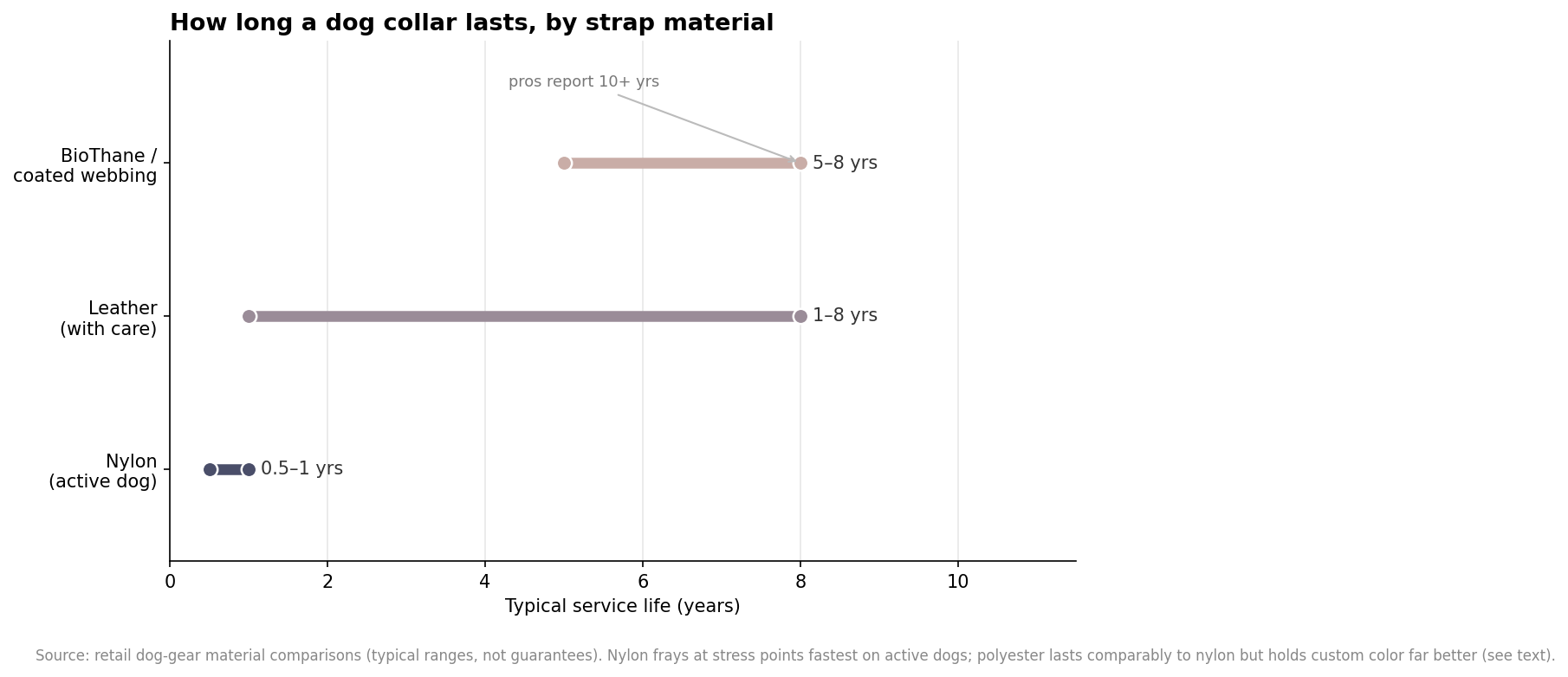
    Range chart of typical dog collar service life by material: nylon 0.5 to 1 year, leather 1 to 8 years, BioThane 5 to 8 years
    Typical service-life ranges by strap material; the wide spread for leather reflects how much it depends on upkeep.

    Two specification details amplify whatever material you pick. Webbing width and weight set both strength and comfort: a wider, heavier strap spreads load and resists fraying, which matters most on large or pulling dogs, while a narrow strap suits toy breeds where a broad collar would be bulky and hot. And the material has to be matched to its hardware, since a strong strap paired with a weak buckle or a thin D-ring simply moves the failure point rather than removing it. The strap and the metal fail as a system, so they should be specified as one.

    The cost that shows up later

    Sticker price and cost of ownership are not the same number, and for collars the gap is large. Cheap nylon looks like the economical choice until you count how often it gets replaced; longer-lived materials cost more upfront but less over the life of the dog. The illustrative comparison below uses single-collar retail figures to make the point clearly. Bulk custom pricing works differently, but the underlying logic carries straight into a wholesale decision: if you are producing collars that carry your brand, a material that fades or frays quickly costs you in reprints and in how the product represents you long after the sale.
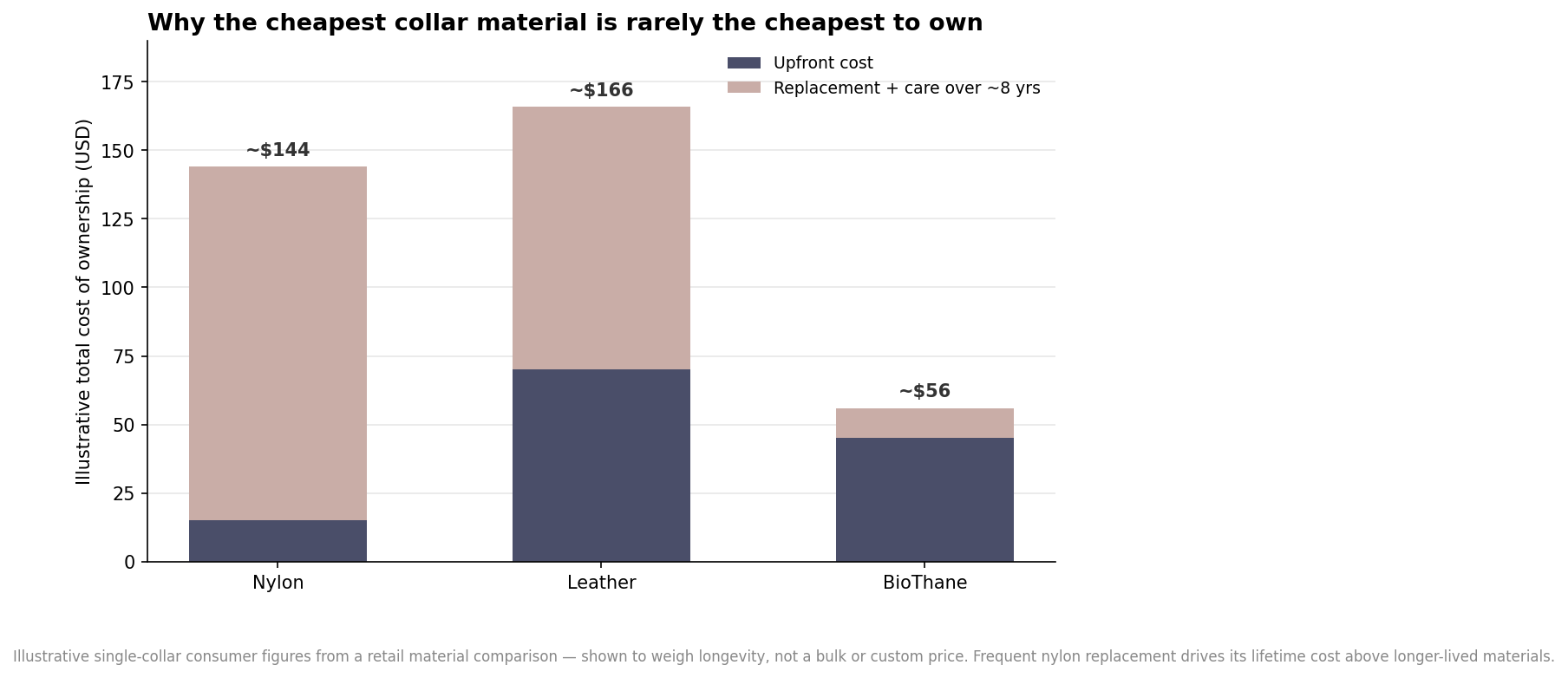
    Stacked bar chart of illustrative eight-year cost of ownership: nylon about $144, leather about $166, BioThane about $56
    Illustrative cost of ownership: frequent replacement makes cheap nylon expensive over a dog’s life.

    Choosing a base material for a custom run

    Start from how the collars will be used and how they will be decorated, and the material usually chooses itself. If the order is built around vivid, full-coverage artwork, specify polyester webbing so the print stays sharp and colorfast. If the collars are aimed at working, sporting, or water dogs and need to survive years of abuse, coated webbing like BioThane is the durable answer, with branding handled through embossing, hardware, or tags. If the run is a premium, low-activity lifestyle product where look and feel justify the upkeep, leather earns its place. Reserve plain nylon for genuinely price-driven or short-term uses, and go in knowing its printed color will not age as gracefully. Whatever you choose, order a printed sample in the exact material and hardware before the full run, then wet it, flex it near the buckle, and leave it in the sun for a few days. Those three tests predict how ten thousand collars will hold up far better than any spec sheet.
  • How Custom Dog Collars Are Decorated: Sublimation, Screen Print, Woven, and Engraving

    How Custom Dog Collars Are Decorated: Sublimation, Screen Print, Woven, and Engraving

    The word custom on a dog collar can mean four or five completely different manufacturing processes, and they are not interchangeable. One dyes a full-color pattern permanently into the webbing; another stitches thread that a dog’s nails can eventually catch; another is a metal plate that will outlive the collar. If you are ordering collars in bulk with a logo, a repeating pattern, or a pet’s name, the decoration method decides how the finished product looks, how long the artwork survives, and what it costs per unit. Here is how the main methods actually differ, and how to match one to your design.

    Dye-sublimation: full color that lives in the fiber

    Dye-sublimation is the method behind photographic, edge-to-edge patterns on webbing. Special inks are turned to gas under heat and bond directly into the fibers, so the color becomes part of the material rather than a layer sitting on top. The practical payoff is durability: a sublimated design cannot be scratched off and does not fade or lighten with normal wear, which makes it a strong choice for dogs that scratch at their collars. The one hard constraint is the substrate. Sublimation bonds to polyester, not nylon, so a full-color sublimated collar is a polyester-webbing product by definition. If you want a busy pattern, a gradient, or a photo-like image across the whole strap, this is almost always the method.

    Screen print and embroidery: spot color and thread

    Screen printing pushes ink through a stencil onto the webbing, one screen per color. It is efficient for simple, bold spot-color logos and text, but it has two limits worth knowing: the number of distinct colors is capped by the number of screens, and the ink sits on the surface, so it can crack or wear over years of handling. Embroidery takes the opposite approach, building a name or small logo from stitched thread. It reads as high quality and holds color well because the color is the thread itself, but the raised stitches occupy real estate and, as collar makers note, can be caught by a dog’s nails during persistent scratching. Embroidery suits names and compact marks far better than large or photographic artwork. A useful rule of thumb: screen print rewards flat, high-contrast shapes with clean edges, while embroidery rewards short text and simple icons where the stitch direction can follow the form.

    Woven webbing and engraved hardware: built-in and permanent

    Jacquard weaving builds the pattern into the webbing on the loom, using colored threads rather than ink. The result is exceptionally durable because there is no surface layer to wear, and it has a distinctive textured look, but the palette is limited to a handful of thread colors and fine photographic detail is off the table. It shines for repeating logos and geometric patterns produced at volume. Engraved hardware is a different animal entirely: a name and phone number laser-etched or debossed into a metal buckle or a riveted nameplate. It carries no field color and only a small amount of text, but it is effectively permanent and pairs with any webbing decoration, which is why identification is often engraved even when the strap itself is printed or woven.

    Matching method to color, wear, and webbing

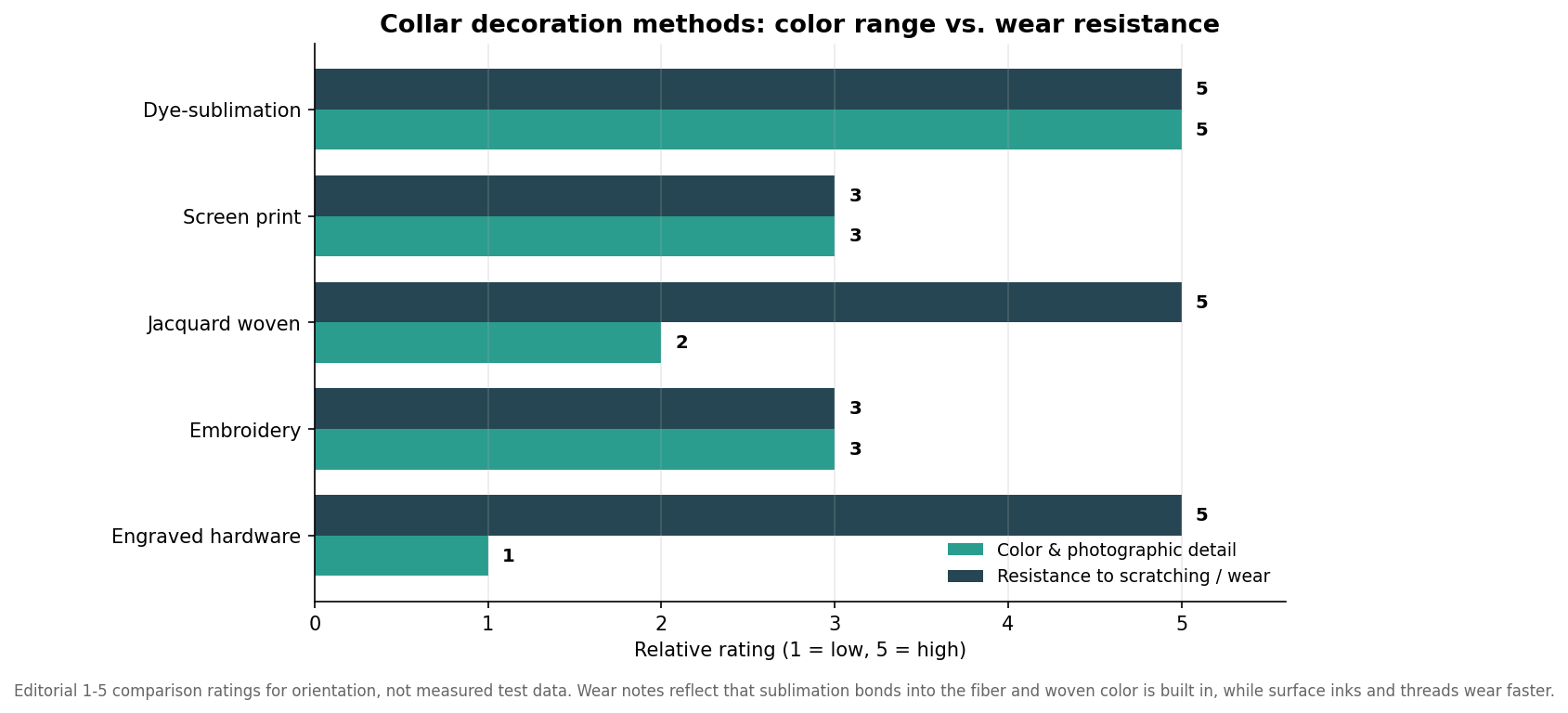
    Line the methods up against the two things buyers care about most, color capability and how well the decoration survives, and the choice usually makes itself. Full-color, photographic, or gradient artwork points to sublimation. A simple bold logo in one or two colors is a natural screen print. A repeating pattern you want to feel premium and last for years leans woven. A pet’s name is embroidery or an engraved plate. The chart below is an orientation aid rather than a lab result, but it captures the trade-off: the methods that carry the richest color are not always the ones that resist wear the best.

    Grouped bar chart rating collar decoration methods on color range versus wear resistance
    How the decoration methods trade color range against resistance to wear (orientation ratings).

    Remember that the method can dictate the webbing, not just the artwork. Choosing sublimation commits you to polyester; choosing woven commits you to a loom setup and a limited palette. Decide the look first, then let it tell you which webbing and process the order actually requires.

    Width is your design canvas

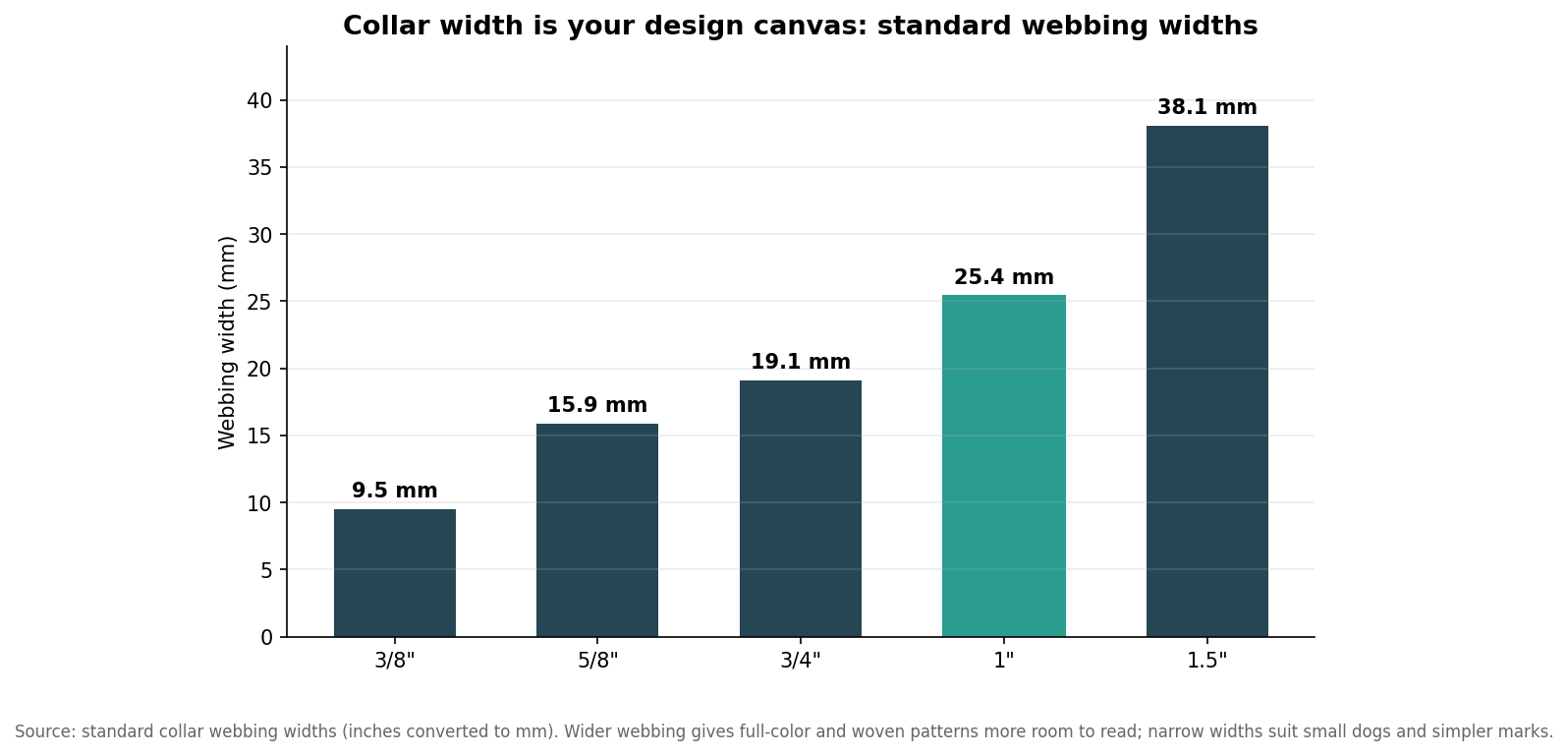
    Whatever method you pick, the collar’s width sets how much design can actually read. Standard webbing runs from three-eighths of an inch for the smallest dogs up to an inch and a half for the largest, and each step up gives a pattern or logo meaningfully more room. A detailed sublimated image or a woven repeat needs the width to breathe, which is why busy artwork looks crisp on a one-inch strap and muddy on a three-eighths-inch one.

    Bar chart of standard dog collar webbing widths from three-eighths inch to one and a half inch in millimeters
    Standard webbing widths, the canvas each decoration method has to work with.

    Match the ambition of the artwork to the width you are ordering. Fine multi-color detail belongs on wider webbing; a narrow collar for a small dog is better served by a simple mark, a single embroidered name, or an engraved buckle than by a crowded full-color print that no one can make out.

    Bring the design and the constraints together before you request a quote: the artwork type, whether it is full color or a few spot colors, the webbing width you need for the dog size, and how hard the collar will be worn. Minimum order quantities and per-unit pricing shift with the method, the number of colors, and whether custom webbing is involved, so treat any single figure as indicative until it is quoted in writing. Choose the decoration method deliberately and the collar that arrives shows the design you intended and keeps showing it after a year of walks.

  • Choosing a Custom Dog Collar: Size, Width, Material, and Personalization

    Choosing a Custom Dog Collar: Size, Width, Material, and Personalization

    A custom dog collar has to do three jobs at once: fit the dog comfortably, survive daily wear, and carry the dog’s name and a phone number where a stranger can read it. Those jobs pull on different decisions, and the order you make them in matters. Get the width and material right for the specific dog, then choose a personalization method that matches how the collar will be used, and the finished collar works for years. This is a selection guide built around the dog in front of you rather than a catalog of options.

    Measure first, then read the size chart

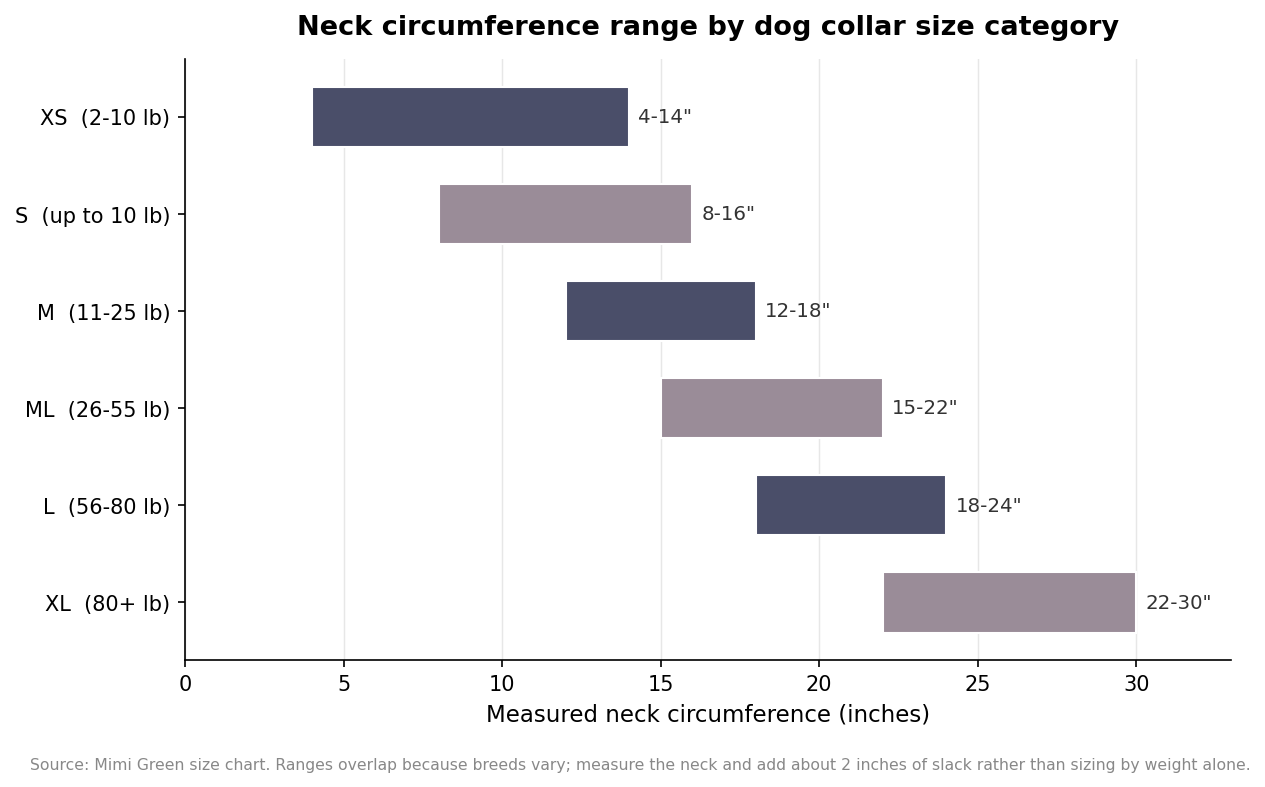
    Every good collar decision starts with a measured neck, not a guess. Wrap a soft tape around the base of the dog’s neck where the collar naturally sits, then add roughly two inches of slack so two fingers slide comfortably underneath. Sizing by breed or weight alone is where most fitting errors begin, because neck circumference varies widely within a size class and the published ranges overlap. The chart below shows typical neck ranges by size category alongside a rough weight band, and the overlap is the point: a heavy-coated medium dog and a lean large dog can land on the same measurement.

    Range bar chart of dog neck circumference in inches by collar size category from XS to XL with weight bands
    Typical neck circumference by collar size category; ranges overlap, so measure rather than size by weight alone.

    When a measurement falls between two sizes, size up. A collar that runs slightly long can be taken in on the buckle holes, while one that runs short cannot be extended, and a collar that is genuinely too small is both uncomfortable and a safety problem. For a growing puppy, plan to replace the collar rather than buying large and cinching it down, since a bunched, oversized collar chafes and slips.

    Match the webbing width to the dog

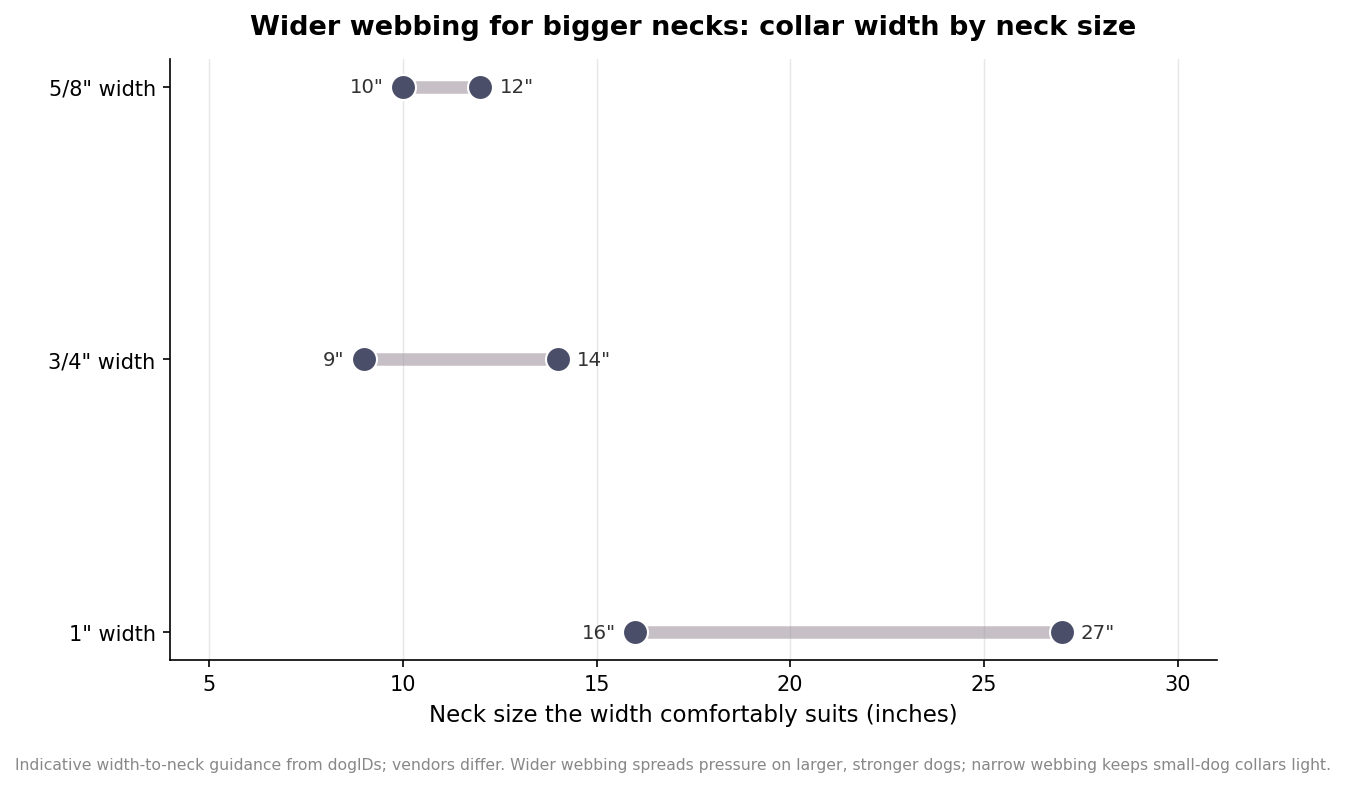
    Width is a comfort and control decision, not just an aesthetic one. Narrow webbing around five-eighths of an inch keeps a small dog’s collar light and unobtrusive and suits necks in roughly the 10 to 12 inch range. A three-quarter inch width is the versatile middle ground for many medium dogs, and a full one-inch width is the workhorse for larger, stronger dogs with necks in the high teens and twenties. The chart below maps these standard widths to the neck sizes they comfortably serve.

    Dot and range chart mapping standard collar webbing widths of 5/8, 3/4, and 1 inch to the neck sizes they suit
    Standard collar widths and the neck sizes each comfortably suits, from 5/8 inch for small dogs to 1 inch for large ones.

    The reason wider webbing matters on a big dog is pressure. A strong dog that pulls concentrates force on a narrow band, and a wider strap spreads that load across more of the neck, which is gentler and less likely to dig in. The reverse is also true: a one-inch strap on a toy breed is heavy, stiff, and overwhelming. Width should track the dog’s size and strength, and only after that its looks.

    Let the material decide the maintenance

    The webbing material governs how the collar handles water, mud, odor, and time. Nylon is the default for good reason: it is lightweight, soft against sensitive necks, takes bright dyed colors and woven patterns well, and keeps cost down for volume orders. Its weakness is that it absorbs water and can hold odor if a dog swims or rolls often, and it benefits from periodic washing. Biothane, a tough nylon core coated in a non-porous material, answers exactly that problem: it is effectively waterproof and odor-proof, wipes clean with a damp cloth, and suits dogs that spend time in water or on the trail, at a higher price than plain nylon. Leather sits at the traditional end, extremely durable and softening beautifully over time, but it needs a break-in period and is happiest in dry conditions, since repeated soaking degrades it. Choosing among the three is really a question of the dog’s lifestyle: a swimmer points to biothane, a couch companion to nylon, and an owner who wants a collar that ages into character to leather.

    Choose how the name and number go on

    Personalization is where a custom collar earns its keep, and the methods differ sharply in durability and readability. Embroidery stitches the phone number directly into the nylon webbing, so it is readable from a short distance and cannot fall off, though it relies on good thread-to-webbing contrast and stays sharpest with occasional cleaning. A laser-engraved buckle uses an industrial fiber laser to cut the information deep into the metal, producing a mark that does not wear away and keeps the collar silent because there is no dangling tag. A rivet-on nameplate is the dependable classic, a metal plate fixed flat to the webbing that stays silent and legible for the life of the collar. A back-of-neck nameplate, sometimes called a scruff plate, moves the text to the top of the neck where it is easy to read without reaching under a nervous dog’s chin and offers the most room for multiple lines.

    The right method follows the priority. If silence matters, because a jingling tag drives an owner or a household to distraction, engraved buckles and riveted plates win over anything that hangs. If maximum readable text is the goal, a larger nameplate beats embroidery. If low cost across a big order is the driver, embroidered nylon is efficient and holds up well. What all the integrated methods share is that, unlike a hanging tag, they cannot be lost, which is the core safety argument for personalizing the collar itself.

    Putting the collar together

    Work the decisions in order and they reinforce each other. Measure the neck and add slack, pick the size and then the width that fits the dog’s build and strength, choose the webbing material that matches how wet and dirty the dog’s life is, and finish with a personalization method chosen for whether silence, readable text, or unit cost matters most. Every number here is a starting point to confirm against a specific product, since widths, size ranges, and material options vary by maker. Specified this way, the collar fits the dog rather than the average, and the name and number stay put where they are needed.

  • Measuring a Dog for a Collar (Properly)

    Most returns in this category are fit, not quality. Five minutes with a tape measure prevents almost all of them.

    Measure where the collar will sit

    Not at the top of the neck under the jaw, and not down on the shoulders. A collar sits in the middle of the neck, and that is where the tape goes, with the dog standing rather than sitting.

    Use a soft tape or a piece of string you can measure afterwards. A steel rule around a moving dog measures nothing useful.

    Two fingers, every time

    Slide two fingers flat under the tape. If they fit snugly, the measurement is right. If your whole hand fits, the collar will come off over the head; if nothing fits, it is too tight for a dog that will gain a winter coat.

    Coat thickness genuinely matters. A double-coated dog measured in August is a different number in January, which is why we build adjustment range into every collar.

    Martingales need the head as well

    A limited-slip collar works because its closed size is smaller than the skull and bigger than the neck. Measure the widest part of the head, over the ears, and send both numbers.

    Without the head measurement we are guessing at the one dimension the design depends on, and a martingale sized only to the neck is just a collar that tightens.

    Puppies and growth

    Buy for now with room to adjust, and expect to replace rather than stretch. A collar bought three sizes large so it will ‘last’ is a collar the puppy backs out of in week one.

    For litters, color-coded collars in a small width are the standard approach, replaced with a named collar at the point the puppy goes home.

    Write it down

    Record each dog’s neck measurement and the collar size supplied. For a kennel or a rescue this turns every reorder into a spreadsheet rather than an afternoon with a tape measure.

    We keep the list on file too, so a repeat order can be one line of email.

  • The Complete Buyer’s Guide to Custom Dog Collars

    A collar is a simple product with a small number of ways to go wrong. Decide these four things and the rest is decoration.

    Material is decided by how wet the dog gets

    Nylon webbing is the sensible default: it dries fast, washes clean, takes color and print well, and does not stiffen after a soaking. It is what most dogs should be wearing most of the time.

    Leather is for the collar that is worn daily for years and handled often — it softens to the neck and looks better with age, provided it is dried away from heat and oiled occasionally. Biothane, a coated webbing, is the answer for a dog that swims constantly: it is wiped rather than washed and it never absorbs anything.

    Width follows the dog, not the look

    Wider webbing spreads load and is the right call for a large or strong dog. On a whippet or a small terrier the same width is heavy, sits badly and rubs.

    A collar that is too wide for the neck it sits on will be taken off and left off, which is the worst outcome of all. Match the width to the dog and let the artwork adapt.

    The hardware is the part that actually fails

    Ask two questions before buying anything. Is the D-ring welded, or is it a bent strip with a gap? A gapped ring opens under a hard pull and the lead comes away.

    And what is the buckle rated for? Side-release buckles come in sizes, and a buckle sized for a terrier fitted to a collar sold for a big dog is the most common breakage we replace. For large or strong dogs, specify aluminum.

    Bar-tacking matters as much as thread count: the stitching that holds the D-ring and the slider is where the load goes.

    Put the ID on the collar, not on a ring

    A hanging tag catches on crates, wears through its split ring and rattles all night. Stitched or riveted ID does none of that and cannot be lost.

    Because a tag is easier to update, many owners run both: permanent details stitched in, and a tag for whatever changes. What matters is that the number survives the day the dog gets out, which is the one day it is needed.

    What to send when you ask for a quote

    Material, width, quantities, the dogs you are buying for, and your list of names and numbers. That is enough for a real quote and a mockup the same day.

    If any of the collars are martingales, send the head measurement as well as the neck. The closed size has to fall between the two, and a size chart cannot tell us that.

  • Collar Hardware: What Actually Breaks

    Webbing almost never fails. Everything attached to it does, and all three failure points are visible before you order if you know what to look at.

    The D-ring

    A welded ring is a closed loop. A cheaper ring is a bent strip with the two ends butted together, and under a hard sideways pull those ends separate and the lead comes off.

    You can see the join. If a supplier cannot tell you whether their rings are welded, assume they are not.

    The buckle

    Side-release buckles are made in sizes and rated accordingly. The failure is rarely a bad buckle; it is a small buckle fitted to a collar sold for a big dog.

    Ask what is fitted and what it is rated for. For very large or very strong dogs, or anywhere the collar takes tie-out loads, use aluminum or a metal-tongue buckle instead.

    One point in favor of plastic: it releases under load, which is what you want if a collar snags on a fence.

    The stitching

    Load concentrates where the D-ring and the slider are attached. That is what a bar-tack is for — a dense block of stitching designed to take it.

    A straight run of stitching in the same place looks similar and is not the same thing. Look for the tight rectangular block.

    Checking a collar you already own

    Look at the ring for a join. Pull the buckle apart and look for stress whitening around the prongs. Check the bar-tacks for lifted threads.

    Do it at the start of every season rather than after something goes wrong. A collar is the cheapest item in the kit and the only one holding on to the dog.

  • Hello world!

    Welcome to WordPress. This is your first post. Edit or delete it, then start writing!